


True or false: the best source of vitamin D is healthy whole foods. Answer? It’s actually false! While vitamin D is critically important for so many components of our health, it’s actually not too easy to find naturally in many foods. Because of this, many people end up deficient in vitamin D.
So what happens when you don’t get enough? We’re getting into the D-ficiency discussion below – what causes ? What are symptoms? What are optimal vitamin D levels? And how much vitamin D per day should you take?
Vitamin D Deficiency Causes
For most otherwise healthy adults, vitamin D deficiency results from lack of sun exposure and the active vitamin D synthesis that occurs in the body in response to sunlight. But in some cases, individual requirements can be higher based on age, life stage, or health status. Vitamin D deficiency can be tied to three primary causes:
Lack of Sun Exposure
- For people living in Northern climates, except during the summer months the skin makes little if any vitamin D from the sun at latitudes above 37 degrees north, which includes about two-thirds of the United States, basically anything north of Arizona, Texas, or North Carolina.
- Excessive avoidance of sunlight may help preserve health skin, our bodies naturally require some sun exposure to create active vitamin D. While we certainly want our skin to stay healthy, try to spend at least 10 minutes outdoors in bright sunlight every day (weather-permitting) to ensure your body’s vitamin D factory gets its fill.
- Those of us with darker skin pigmentation simply don’t absorb as many of the sun’s rays that support vitamin D synthesis. The higher concentrations of melanin in dark skin means that these individuals should aim for 25-30 minutes of daily sunlight to meet their needs.
Higher Vitamin D Requirements
- While breastfeeding, moms need enough vitamin D for themselves and their babies. That means that the vitamin D requirements for nursing women often exceed the 600 IU (15 mcg) recommended daily value. While some lactation experts advise supplementing with ten times this amount, your primary doctor or OB-GYN is the best judge of how much extra you and your little one need.
- Older adults generally require more vitamin D for maintaining bone health, immune health, and brain health. They may also be less efficient at converting vitamin D, which puts this population at a higher risk of deficiency. Adults over age 70 are recommended to take 800 IU (20 mcg) per day.
Health Status
- Recent research has demonstrated that vitamin D is less available in overweight individuals. This is because vitamin D is stored in fat, and those with higher fat stores are prone to store vitamin D rather than keep it in circulation.
- As vitamin D is fat soluble, those with difficulty digesting fat are at a higher risk of insufficient absorption of vitamin D. Likewise, intestinal health conditions can also limit the amount of vitamin D that is absorbed and used by the body.
- Some genetic mutations may affect how our bodies absorb nutrients. Just as the MTHFR mutation can affect the absorption of folic acid, the VDR gene mutation can impact the body’s ability to convert or use vitamin D.
- As the kidneys and liver are involved in the conversion and assimilation of vitamin D into the body, complications with these organs can lead to a vitamin D deficiency.
Vitamin D Deficiency Symptoms
Of course, the best way to determine whether you are deficient in vitamin D is to get your levels tested. You can request testing through your provider or find it through a reputable third-party lab. Your lab will likely have a reference range, but a generally accepted optimal range is 32-80 ng/mL.
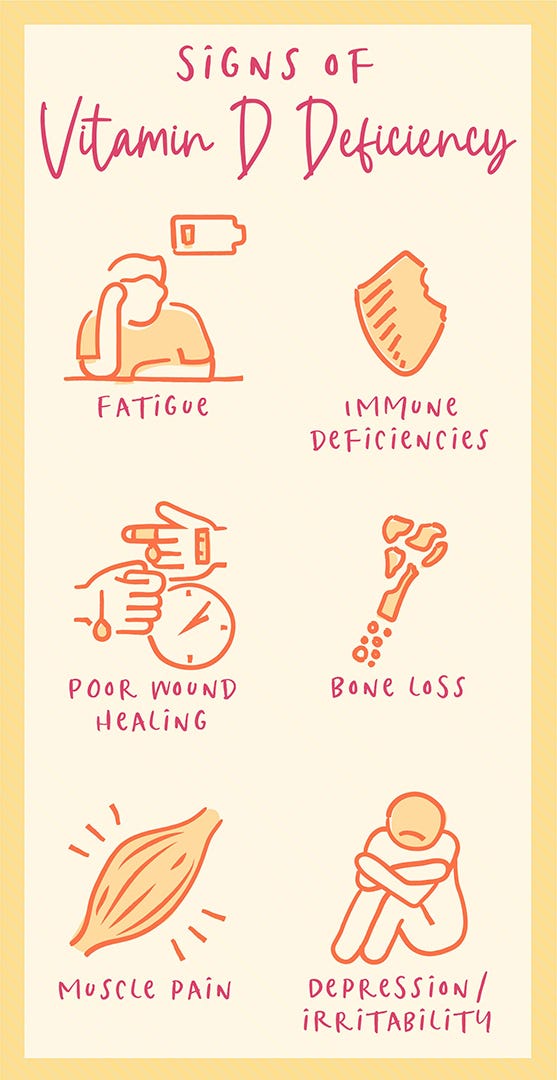
To help you decide whether you should have your vitamin D levels tested, here are some common vitamin D deficiency symptoms to be aware of:
- Poor immune health
- Fatigue/tiredness
- Muscle aches
- Bone or muscle discomfort
- Slow wound healing
- Hair loss
- Mood swings
Vitamin D Deficiency Support
While vitamin D deficiency can be replenished through natural sources of vitamin D like sun and certain plant and animal foods, practitioners typically recommend supplementation to ensure that the deficiency is resolved before transitioning to a maintenance dose of vitamin D. However, for completeness, we’ll touch on all sources of vitamin D:
Sun
Vitamin D is synthesized in the skin following UVB exposure.
Food
Plant foods contain vitamin D2 (ergocalciferol) which must be converted into the active form used by the body. Unfortunately, this conversion rate is not always reliable or efficient. Animal foods contain vitamin D3, which is metabolized more efficiently as D3 than D2.
- Plant Sources: Vitamin D2 is found in small amounts in mushrooms (about 15-20 IU/cup).
- Animal Sources: Vitamin D3 is found in cod liver oil (400 IU/tsp), salmon (450 IU/3 oz.), mackerel (500 IU/3 oz.), sardines (25 IU each), and egg yolk (40 IU/yolk). These sources are much richer and already contain the active form. However, they are unavailable to those following a vegan or vegetarian diet.
Supplements
There are a wide range of supplements available, but many contain the less absorbable form of D2, or fail to include the necessary cofactors or “helper nutrients” needed for the body to properly absorb and use vitamin D. D3+K2 Complex combines vegan sources of vitamin D3 and vitamin K2 along with fermented K1, plus an organic food complex of shiitake mushroom mycelia, camu camu berry, collard greens, spinach, parsley, and cruciferous sprouts.
How much Vitamin D Per Day Do You Need?
There’s no one-size-fits-all answer to the question of how much vitamin D per day you need. This is because the amount you need depends on your individual situation – your needs, your environment, and your current levels.
Research suggests that optimal serum vitamin D levels should be in the range of 32-80 ng/mL. Therefore, if you are at the low end or below this range, your needs are much higher than if you are on the higher end of the range and just looking to maintain. They are also higher if you happen to live in a northern climate or have a desk job that keeps you indoors away from sunlight most days of the week. In addition, you may want to increase your vitamin D heading into spring and winter for extra immune support.
In terms of amount per day to maintain optimal vitamin D supplies (once levels are well within the optimal range), we often look to the recommended daily allowance (RDA). However, the RDA for vitamin D is one of the most hotly contested recommendations. While the RDA suggests 600 IU or 15 mcg for adults age 19-70 and 800 IU or 20 mcg for adults over age 70, most experts recommend higher levels of 1000-2000 IU/day or more.
One capsule of our D3 + K2 Complex offers 2000 IU or 50 mcg of D3 alongside 120 mcg of K1, 100 mcg of K2, and 45 mg of Vitamin C for optimal absorption. This amount can act as an effective maintenance dose and can be safely combined with your multivitamin supplements. If your doctor determines you have a deficiency, you may be advised to take 2 capsules for a short time to re-establish your stores.


 Your Privacy Choices